CLOUD ASSESSMENT | SOLUTION ARCHITECTURE | MIGRATION EXECUTION
ASSESS. ARCHITECT. MIGRATE. WITH CONFIDENCE.
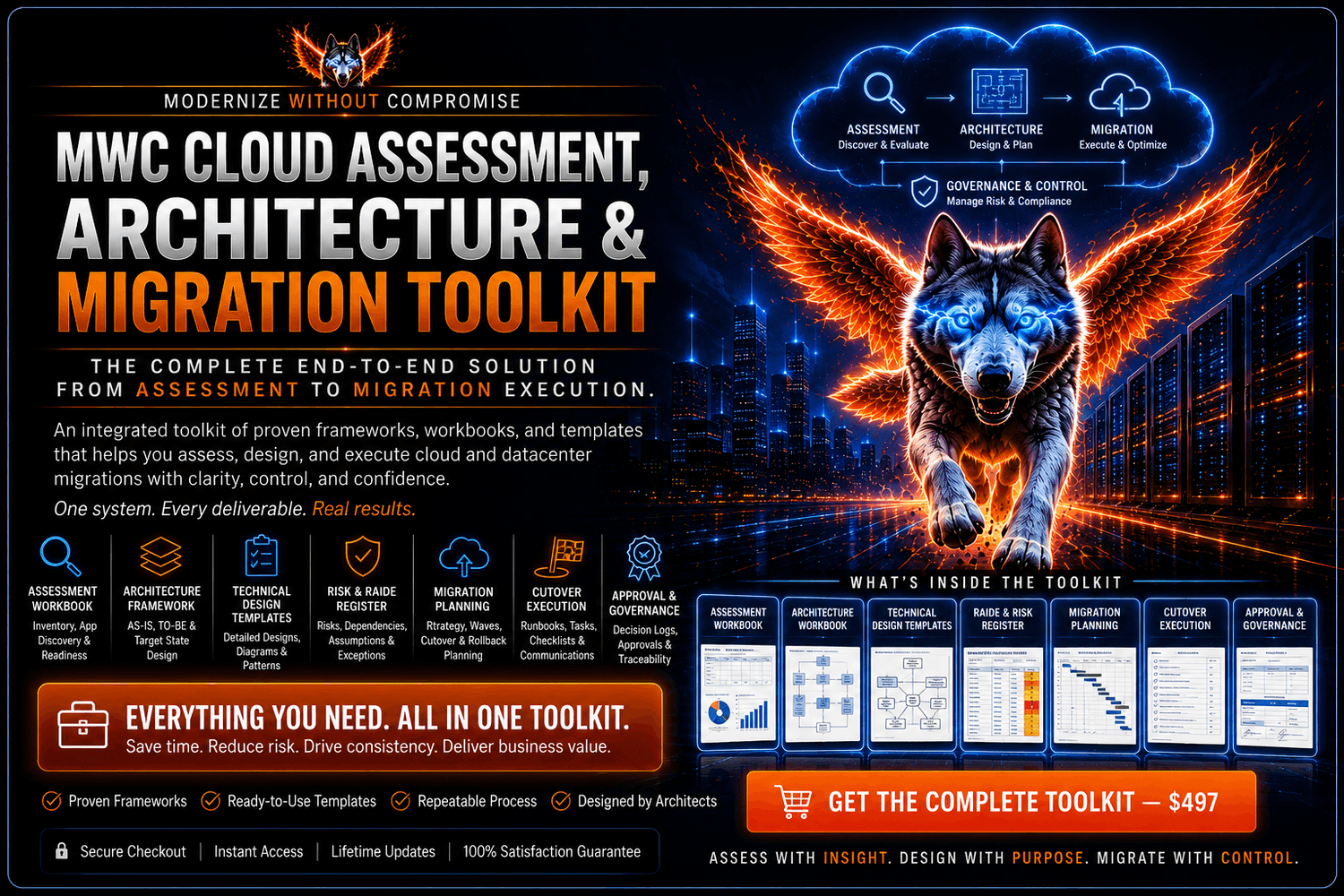
A complete end-to-end toolkit that connects cloud discovery, assessment, solution architecture, and migration execution through one structured, reusable system.
WHAT YOU'RE GETTING
The MWC Cloud Assessment, Architecture & Migration Toolkit brings together the major working systems required to move a cloud initiative from early discovery through architecture and migration execution.
This is not a single spreadsheet or a collection of disconnected templates.
The toolkit is designed around an end-to-end delivery flow:
ASSESSMENT & DISCOVERY → REQUIREMENTS → ARCHITECTURE DECISIONS → AS-IS → TRANSITION → TO-BE → MIGRATION HANDOFF → WAVES & MOVE GROUPS → DEV → TEST → UAT → PROD → CUTOVER → VALIDATION → HYPERCARE → CLOSURE
Each stage produces information needed by the next stage.
The objective is to create continuity between the people assessing the environment, the architects designing the solution, and the teams responsible for executing the migration.
Instead of losing critical information between discovery, architecture, and migration, the toolkit gives you a structured framework for carrying those decisions forward.
WHAT'S INSIDE THE TOOLKIT
CLOUD ASSESSMENT & DISCOVERY
Build the foundation for the initiative before architecture or migration planning begins.
Use structured discovery to capture the business, application, infrastructure, platform, database, network, security, operational, dependency, and migration information needed to understand the existing environment.
The assessment layer helps teams identify:
Business & Technical Drivers
Document why the initiative exists, what outcomes are expected, and which technical or operational conditions are driving change.
Application Discovery
Capture application ownership, criticality, technology, dependencies, environments, integrations, business importance, and migration considerations.
Infrastructure Discovery
Document servers, compute, operating systems, capacity, storage, hosting locations, utilization considerations, and infrastructure relationships.
Database & Data Discovery
Capture database platforms, versions, capacity, availability requirements, backup/recovery considerations, dependencies, and migration requirements.
Network & Connectivity Discovery
Identify connectivity, network dependencies, interfaces, endpoints, firewall considerations, DNS, routing, and hybrid connectivity requirements.
Security & Compliance Discovery
Capture identity, access, encryption, logging, regulatory, governance, security-control, and compliance requirements.
Dependency Discovery
Identify application-to-application, infrastructure, database, network, security, operational, and external dependencies that can affect architecture and migration sequencing.
Migration Readiness Inputs
Turn discovery findings into information that can support migration strategy, architecture requirements, workload grouping, sequencing, risk identification, and planning.
SOLUTION ARCHITECTURE DESIGN
Move from discovery findings into a documented architecture decision process.
The MWC Solution Architecture Design Workbook provides the working structure for translating business and technical requirements into an architecture that can be reviewed, governed, approved, and handed to implementation and migration teams.
Architecture Dashboard
Create an executive-level view of architecture requirements, decisions, risks, dependencies, and migration readiness.
Architecture Overview
Document the initiative, business outcome, architecture pattern, platforms, current state, transition state, target state, constraints, dependencies, risks, and overall architecture status.
Business Drivers, Success Criteria, Scope & Constraints
Connect architecture decisions directly to the business reasons behind the initiative and clearly establish what is—and is not—part of the solution.
Design Requirements & Traceability
Transform discovery findings into measurable architecture requirements and connect those requirements to architecture decisions and target-state components.
AS-IS Architecture
Document the current environment, including applications, infrastructure, technologies, locations, dependencies, network relationships, and existing architecture.
Transition Architecture
Capture the temporary and hybrid architecture required while workloads move between the existing and target environments.
TO-BE Architecture
Define the future-state solution and document the components, services, relationships, and technical decisions required to support it.
Architecture Diagram Examples
Use AS-IS, Transition, and TO-BE architecture examples as visual references when developing project-specific architecture documentation.
Application & Integration Design
Document application tiers, interfaces, protocols, ports, source/destination relationships, dependencies, availability requirements, and security requirements.
Infrastructure & Platform Design
Capture compute, operating system, runtime, sizing, CPU, memory, storage, scaling, platform, and management-tooling decisions.
Network & Connectivity Design
Design VPC/VNet structures, subnets, CIDRs, routing, DNS, hybrid connectivity, firewall requirements, ports, and protocols.
Security & IAM Design
Document identity, authentication, authorization, encryption, logging, monitoring, compliance mappings, and security controls.
Data, Database & Storage Design
Capture database technologies, capacity, performance, replication, backup, retention, encryption, residency, and data requirements.
HA, DR & Resiliency Design
Define criticality, availability targets, RTO, RPO, high-availability patterns, disaster-recovery patterns, failover, testing, and monitoring.
Architecture Decision Register
Document major architecture decisions, alternatives considered, selected options, rationale, trade-offs, ownership, and approval.
RAID & Dependency Register
Track risks, assumptions, issues, dependencies, and exceptions that can affect the architecture or delivery.
Architecture-to-Migration Handoff
Translate approved architecture into migration inputs including strategy, prerequisites, dependencies, testing requirements, recovery requirements, rollback considerations, and readiness.
Approval & Sign-Off
Create the documented governance trail for architecture reviews, conditions, decisions, evidence, and final approval.
MIGRATION WAVE & CUTOVER MANAGEMENT
Once the architecture is ready for execution, move into a structured migration-management system rather than rebuilding project trackers from scratch.
The MWC Migration Wave & Cutover Workbook provides a 30-sheet migration management system covering planning, execution, environment progression, cutover, validation, stabilization, and closure.
Migration Dashboard
Get an executive view of migration progress, readiness, workload status, risks, issues, cutover activity, and overall migration health.
Migration Overview
Establish the migration scope, objectives, timeline, strategy, environments, delivery approach, ownership, assumptions, constraints, and overall migration context.
Architecture Handoff
Capture approved architecture inputs that migration teams need before execution begins.
Migration Portfolio
Maintain the workload inventory that drives migration planning—including applications/services, source and target environments, strategy, wave, move group, status, ownership, health, and blockers.
Wave Planner
Organize workloads into migration waves based on dependencies, business priorities, technical requirements, readiness, and delivery constraints.
Move Groups & Batches
Break migration waves into executable groups and batches so related workloads can be coordinated and controlled.
Wave Readiness
Determine whether each wave is actually ready to proceed by tracking prerequisites, dependencies, approvals, testing, change readiness, technical readiness, and outstanding blockers.
Environment Migration Map
Control the workload journey through the environments that actually apply to each workload.
Support:
DEV → TEST → UAT → PROD
while allowing environments to be marked Required, Not Required, or N/A so teams aren't forced to report artificial completion for environments that don't apply.
DEV Migration — Prove the Migration Pattern
Document the first execution of the migration approach, validate connectivity and access, identify procedure corrections, capture lessons learned, and establish a repeatable migration pattern before promotion.
TEST Migration — Prove Repeatability & Integration
Repeat the migration using the refined procedure, verify integrations, validate batch processes, capture issues, and determine whether the migration method can be executed consistently.
UAT Migration — Prove Business Functionality
Track UAT migration activities, business validation, test evidence, formal sign-off, unresolved issues, and their impact on production readiness.
PROD Migration — Controlled Production Cutover
Coordinate production migration readiness, Go/No-Go decisions, cutover references, final synchronization, operational acceptance, and the transition into hypercare.
Build & Configuration
Track infrastructure, platform, application, database, security, networking, and other build/configuration activities required before migration.
Replication & Data Sync
Manage replication and synchronization requirements, status, health, timing, ownership, and readiness for workloads that require data movement or synchronization.
Change & CAB
Track migration change records, submissions, CAB reviews, approvals, implementation windows, environments, workloads, and change status.
Dependency Tracker
Identify and manage application, infrastructure, network, database, security, business, vendor, and cross-workload dependencies that can affect migration sequencing or cutover.
Test Plan & Validation
Document migration testing and validation requirements, expected results, actual results, evidence, ownership, status, and acceptance.
Cutover Runbook
Build the detailed execution sequence for migration events—including task ownership, dependencies, planned and actual timing, duration, status, validation, handoffs, and command-center coordination.
Go/No-Go
Create a documented decision point before production cutover by evaluating readiness, risks, blockers, approvals, dependencies, and required evidence.
Command Center
Coordinate migration-event activity across technical teams, application owners, leadership, vendors, and other stakeholders during the cutover window.
Rollback & Backout
Document rollback criteria, triggers, ownership, backup and recovery requirements, recovery procedures, decision points, and readiness before execution begins.
Risks, Issues & Actions
Track risks, active issues, actions, ownership, severity, status, mitigation, due dates, and resolution throughout the migration lifecycle.
Post-Cutover Validation
Verify migrated workloads are functioning correctly after cutover through technical, application, integration, business, and performance validation.
Hypercare & Stabilization
Track post-production issues, stabilization activities, ownership, operational readiness, outstanding actions, and the transition from migration into steady-state operations.
Decommission & Closure
Manage activities required to retire source environments, remove temporary migration components, complete outstanding actions, confirm ownership transitions, and formally close migration activities.
Lessons Learned
Capture what worked, what failed, what should change, and what future migration waves should inherit from previous execution.
Migration Sign-Off
Create a formal record of migration completion, acceptance, outstanding conditions, evidence, ownership, and final approval.
Built-In Sheet Guide
Every major worksheet explains its purpose, what information belongs there, key components, how it is used, and who should own it—so teams aren't handed a complex workbook and expected to figure it out themselves.
ONE CONTINUOUS DELIVERY SYSTEM
The real value of the toolkit isn't simply the number of worksheets or templates.
It's the connection between them.
Discovery Finding → Requirement → Architecture Decision → Target-State Component → Migration Handoff → Workload → Wave → Move Group → Environment Migration → Dependency → Change → Replication → Cutover Task → Validation → Hypercare → Closure
That creates a documented trail from what was discovered all the way through what was designed, what was migrated, how it was validated, and how it was ultimately closed.
DON'T JUST COLLECT TEMPLATES. BUILD A REPEATABLE DELIVERY SYSTEM.
WCloud initiatives frequently become fragmented across discovery questionnaires, architecture documents, spreadsheets, project trackers, migration plans, change records, and cutover runbooks.
The MWC Cloud Assessment, Architecture & Migration Toolkit is designed to connect those activities into a more structured delivery framework.
SAVE TIME — Start with reusable assessment, architecture, migration, validation, governance, and cutover structures instead of rebuilding them for every initiative.
REDUCE RISK — Surface dependencies, constraints, architecture decisions, readiness gaps, change requirements, rollback conditions, validation requirements, and operational concerns before they become execution failures.
DRIVE CONSISTENCY — Apply a repeatable approach across workloads, applications, environments, projects, clients, and migration waves.
IMPROVE TRACEABILITY — Connect discovery findings and requirements to architecture decisions and carry those decisions into migration planning and execution.
BRIDGE ARCHITECTURE & EXECUTION — Reduce the gap between the team designing the solution and the teams responsible for building, migrating, testing, and operating it.
EXECUTE WITH CONFIDENCE — Give teams a structured way to understand what is ready, what is blocked, what must happen next, who owns it, and what evidence supports completion.
WHO THIS TOOLKIT IS BUILT FOR
Cloud Architects
Move from assessment and discovery through target-state architecture and migration-ready design using a consistent framework.
Solution Architects
Connect business requirements, technical requirements, integrations, infrastructure, security, data, architecture decisions, and migration requirements.
Enterprise Architects
Create greater traceability between business drivers, architecture standards, technology decisions, governance, dependencies, and execution.
Migration Architects & Migration Leads
Translate approved architecture into workloads, waves, move groups, environment progression, cutover activities, validation, and stabilization.
Cloud & Technology Consultants
Bring reusable assessment, architecture, and migration structures into client engagements rather than recreating the delivery process for every project.
Project & Program Managers
Gain structured visibility into ownership, schedules, dependencies, risks, readiness, approvals, execution, issues, and closure.
Technical Leads & Senior Engineers
Understand what must be built, configured, replicated, tested, validated, migrated, recovered, and handed into operations.
Organizations Building a Repeatable Cloud Delivery Practice
Establish a consistent framework that can be reused across workloads, initiatives, business units, cloud platforms, and future migration programs.
BUILT FOR THE ENTIRE CLOUD DELIVERY JOURNEY
Whether you're assessing an existing environment, designing a cloud solution, preparing a modernization initiative, planning migration waves, or coordinating a production cutover, the toolkit gives you a reusable framework for carrying information and decisions from one stage into the next.
You're not purchasing a template that addresses one isolated activity.
You're purchasing a working system designed around the progression:
ASSESS → UNDERSTAND → DESIGN → DECIDE → PLAN → MIGRATE → VALIDATE → STABILIZE → CLOSE
And that gives us the closing CTA:
ASSESS WITH INSIGHT. DESIGN WITH PURPOSE. MIGRATE WITH CONTROL.
ASSESS WITH INSIGHT. DESIGN WITH PURPOSE. MIGRATE WITH CONTROL.
Built with systeme.io | Privacy policy | Legal | Terms and conditions