From Help Desk to Cloud Architect: How Help Desk Skills Build the Foundation for a Cloud Career
From Help Desk to Cloud Architect: How Help Desk Skills Build the Foundation for a Cloud Career
When people look at a Cloud Architect, they often see the destination.
They see AWS, Azure, Google Cloud, OCI, enterprise architecture, cloud migrations, security, modernization, AI, and complex technical designs.
What they don't always see is where the journey began.
For me, it began at the Help Desk.
My first real IT position was with an oil and gas company while I was still completing college. I wasn't designing enterprise cloud environments. I wasn't conducting cloud assessments or presenting architecture strategies to executives.
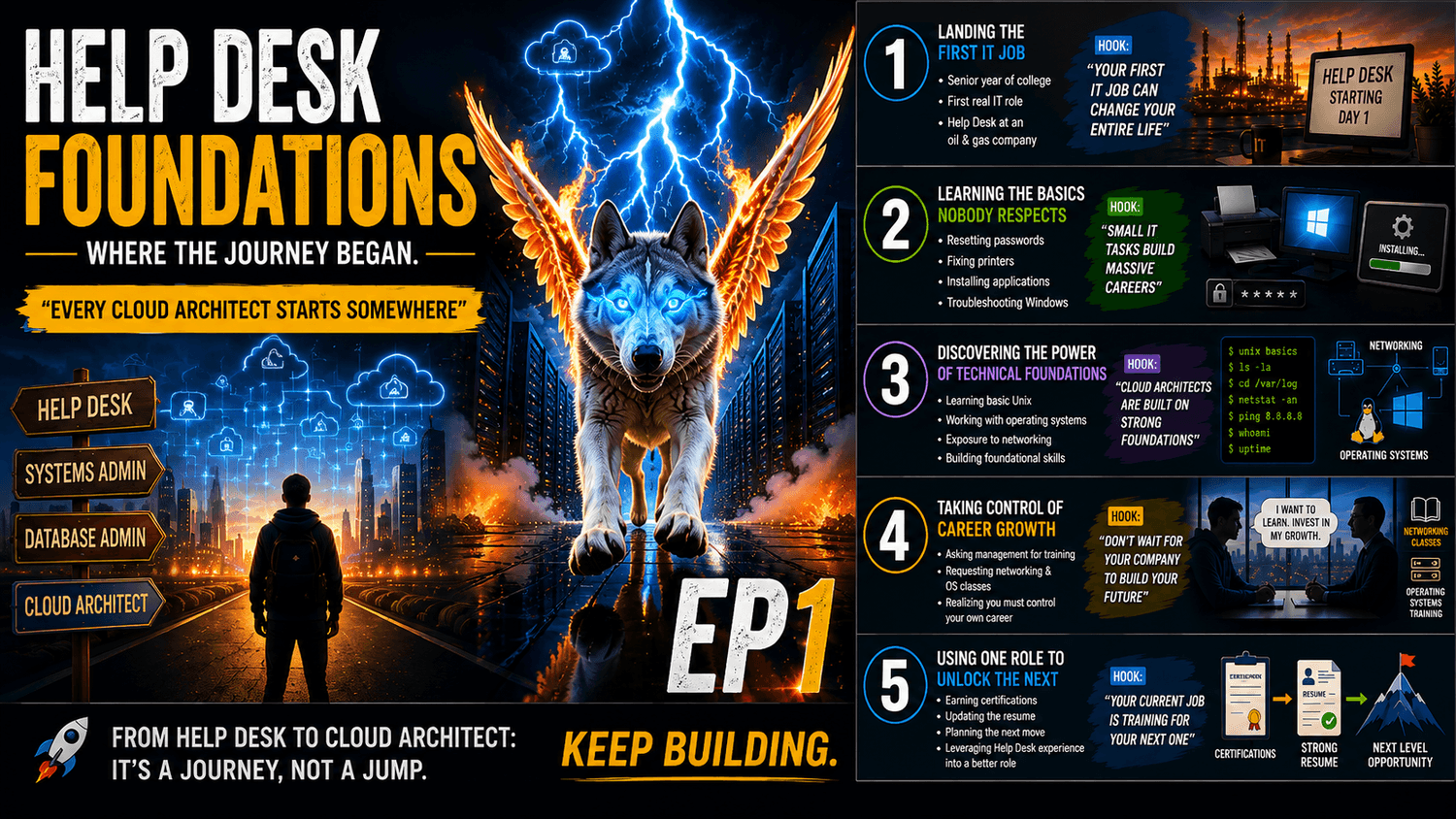
I was resetting passwords, fixing printers, installing applications, troubleshooting Windows, supporting users, and getting exposure to basic Unix and networking.
At the time, those responsibilities might have looked small.
Looking back, they were anything but small.
That Help Desk position became the foundation for a career that eventually took me through Oracle database administration, enterprise systems, consulting, Enterprise Architecture, and ultimately Cloud Architecture.
The lesson I've carried with me ever since is simple:
Never underestimate the value of the fundamentals.
Your First IT Job Is More Than a Job
One of the biggest mistakes someone starting an IT career can make is judging a position only by its title.
"Help Desk" can sound temporary.
It can sound like the place you're trying to escape rather than the place you're trying to learn from.
I chose to look at it differently.
The Help Desk gave me something incredibly valuable: access to a real enterprise technology environment.
I could see users interacting with applications. I could see how operating systems supported those applications. I could see networking problems affecting printers and connectivity. I could see how access issues prevented employees from doing their jobs.
Most importantly, I started seeing that technology wasn't a collection of isolated components.
It was connected.
My Help Desk transcript describes that environment as a laboratory—an opportunity to observe how users, systems, networks, applications, and business operations worked together.
I didn't have the terminology for everything I was observing yet.
But I was learning.
And that distinction matters.
Your current job title tells people what you're responsible for today.
What you choose to learn determines what you may be qualified to do tomorrow.
A Password Reset Can Teach You More Than You Think
Consider something as simple as resetting a password.
It doesn't sound like Cloud Architecture.
But what are you actually dealing with?
You're dealing with identity.
You're dealing with authentication.
You're dealing with authorization and access.
You're dealing with policies controlling who should be able to access a system and what they should be allowed to do once they get there.
Those concepts don't disappear when you become a Cloud Architect.
The environment simply becomes more complex.
The same principle applies to troubleshooting a network printer.
At the Help Desk, you may be asking why a user's computer can't reach a printer.
Later in your career, you might be determining why workloads in different network segments cannot communicate or why an application cannot reach a dependent service. The scale is different. The underlying habit is the same:
Understand the path. Isolate the problem. Determine the dependency. Fix the cause.
My early Help Desk work exposed me to passwords, printers, Windows troubleshooting, applications, operating-system dependencies and user support. Those experiences taught me how technology behaves when actual people depend on it. That is something you cannot learn from certification material alone.
Troubleshooting Is One of the Most Valuable Skills in Technology
One of the most important things Help Desk taught me was how to troubleshoot.
When something isn't working, guessing isn't a strategy. You need to ask questions. What changed? Who is affected? Is this one user or everyone? Is the problem the device? The operating system? The network? The application? A dependency? Permissions? The process of narrowing down possibilities develops technical discipline. That discipline followed me throughout my career. When I eventually moved into Oracle databases, production support and disaster recovery, the systems were far more critical and the consequences of failure were much greater. But the fundamental thought process remained recognizable. Find the problem. Understand what depends on what. Don't panic. Don't make the situation worse. Solve the issue methodically. The technologies changed. The scale changed. The responsibility changed.
The discipline didn't. User Support Teaches a Skill Technology Alone Cannot
There's another part of Help Desk work that aspiring Cloud Architects sometimes underestimate: communication. When a user's system is down, they're usually not interested in hearing how technically interesting the problem is. They want to work.
They may be frustrated. They may not understand what's happening. And you still need to gather information, explain what you're doing, manage expectations and resolve the problem. That experience taught me patience and how to stay composed while someone else was frustrated. Years later, communication became even more important. As my career advanced, I wasn't only working with technology. I was leading teams, interacting with clients and eventually working with executives. My later career included architecture, assessments, migration planning, cost optimization, governance and helping organizations determine the right cloud strategy. My resume reflects work ranging from application and data-center assessments to AWS and Azure architecture, migration planning, landing zones and modernization. The audience changed. The communication equirement never disappeared. A Cloud Architect who understands technology but cannot communicate its business impact will eventually hit a ceiling. Help Desk gave me an early education in both.
I Started Using My Job as a Practical Laboratory
Eventually I stopped asking only:
"What do I need to do today?"
I started asking:
"What can I learn here that will prepare me for where I want to go next?"
That question changed the way I viewed work.
If I was dealing with network printers, I wanted to understand networking better.
If I was working across operating systems, I wanted formal operating-system training. If I encountered Unix, I wanted to understand Unix. Instead of treating the job as a collection of tickets, I started treating it as a collection of learning opportunities. That eventually led me to approach my manager about additional training. I explained that I was already dealing with networking and operating-system issues and that formal training would make me more effective. The company agreed. They paid for my operating-system and networking classes. I added those skills and certifications to my resume and later used that experience to move into a role where I gained more hands-on exposure to servers and hardware.
The important point isn't simply that an employer paid for classes. The important point is that I recognized the opportunity.
I was beginning to take control of my career. We'll go much deeper into that in Part 2.
The Career Path Wasn't a Straight Line
My journey didn't go: Help Desk → Cloud Architect. There were many steps in between. Help Desk eventually led to deeper infrastructure experience. From there, I deliberately targeted Oracle database administration after recognizing demand in the market. I built relationships with Oracle DBAs inside my organization, pursued Oracle training and eventually got the opportunity to become a DBA. That role deepened my Unix skills, scripting, database management, data protection and production support. It eventually led to consulting, Oracle Apps DBA work, large ERP environments, Enterprise Architecture and cloud. By the time I reached Cloud Architecture, I was working with complex enterprise environments and cloud assessments and migrations across AWS, Azure, Google Cloud and OCI. Looking backward, the connection is much easier to see. Help Desk taught me troubleshooting. Database administration taught me data, availability, recovery and production discipline. Consulting exposed me to large projects and business problems. Enterprise Architecture taught me to connect systems and business requirements. Cloud Architecture brought those disciplines together at enterprise scale.
Careers are built in layers. Don't Rush Past the Fundamentals
Technology constantly changes. The tools I used early in my career aren't the same tools Cloud Architects use today. AI is changing technology again. Cloud platforms will continue introducing new services. But fundamentals have an unusually long life. Operating systems still matter. Networking still matters. Security still matters.
Identity still matters. Data still matters. Troubleshooting still matters.
Communication still matters. Understanding dependencies still matters.
That's why I would never tell someone starting at the Help Desk that their work doesn't matter. I'd tell them the opposite.
Learn everything you can from it.
Don't simply reset the password. Understand access. Don't simply reconnect the printer. Understand the network path. Don't simply install the application. Understand what the application requires. Don't simply close the ticket. Understand what caused the problem. That curiosity compounds.
Your Help Desk Job Doesn't Have to Be Your Destination
Where you start matters. But it doesn't have to determine where you finish.
My Help Desk role gave me access to technology, problems and people. What happened afterward depended on what I chose to do with that access.
I learned. I asked questions. I requested training. I built skills. I watched the market.
And eventually I kept moving. If you're currently working at the Help Desk and your goal is Cloud Architecture, don't spend all your energy trying to escape your current position. First, extract everything valuable from it. Your next opportunity may already be hiding inside the problems you're solving today.
In Part 2, we'll go beyond the technical foundation and examine the decision that accelerated everything for me: taking ownership of my career—and beginning the transition from supporting systems to thinking like an architect.
Modernize Without Compromise.
SHARE